The mangrove ecosystem
is characterized by a complex array of tree and shrub species that have evolved
to thrive in the intertidal zones of tropical and subtropical coastlines
globally. These species have developed a tolerance to waterlogged soils and high
salinity conditions (Pomareda & Zanella, 2006). This highly productive and
intricate ecosystem contributes significant nutrients to coastal marine waters,
benefiting seagrasses and various commercially important species (Gaxiola,
2011). Mangroves are typically found along coastlines, estuaries, coastal
lagoons, wetlands, and river mouths. Their ecological significance lies in the
roles that their organisms play in maintaining coastal balance and protection,
providing spawning and feeding grounds for species ranging from fish to
crustaceans, while also offering refuge to crabs, mollusks, and nesting areas
for shorebirds. Economically, mangroves are valued for their role as habitats
for fish species, bark tannins, and wood used in various artisanal and commercial
applications (Olguín et al., 2007).
The richness of larger
mollusks (malacofauna) associated with mangrove ecosystems significantly
influences their biocenotic diversity. Abiotic factors such as salinity
(Flores, 1973), temperature, seasonality, and soil composition regulate
(Newell, 1958) patterns that determine species distribution, density, and
adaptability in varying environments. Biotic factors like predation,
competition, and food availability limit distribution (Connell et al.,
1961; Haven, 1971), in addition to interactions with other factors such as
exposure and distance from the shore (Franz, 1976). Invertebrate communities
within mangrove ecosystems display variations in species density and abundance
by zone, throughout the ecosystem, and across seasons (Jiménez, 1994), often
leading to dominance by a few species that are highly adaptable to
environmental changes. This differs from sandy beach communities where factors
such as larval recruitment (specifically for mollusks, not juvenile fish),
nutrient availability, and environmental conditions—including desiccation and
thermal variation—can have markedly different impacts (Pfaff & Nel, 2019).
However, abundance and diversity may also be influenced by habitat
fragmentation or pollution (Cárdenas-Calle & Mair, 2014).
Mollusk populations
associated with mangrove substrates generally comprise species that reside in
the sediment as ectofauna and various Pelecypoda groups, buried up to 30 cm
deep, representing the endofauna of the mangrove. All these organisms are
marine-affiliated but must also endure temporary aerial conditions during low
tides and the general variations associated with tidal changes (Flores, 1973).
Globally, numerous
studies have been conducted on various aspects of mangrove faunal ecology,
including research on the distribution, zonation, ratio, abundance, density,
and diversity of Mollusca (Pelecypoda and Gastropoda) alongside population
fluctuations over time/season, as well as their associations with substrate
types and vegetation (Emmen & Tejada, 1984). Previous research focused on
mollusks associated with mangroves has primarily emphasized the Pelecypoda
group due to its economic significance and as a food source. Reports indicate
48 species of pelecypods from collections along African coasts, with additional
studies in the west coast of the Americas identifying 11 species, and 10
species noted along the southeast coast of North America, plus 37 species in
the Caribbean and northeast South America (Morton, 1983).
Organisms inhabiting
submerged root regions exhibit impressive adaptation mechanisms, with a
dominance of epizoic, epigenic, and delicate species; some hold significant
commercial value, such as the oyster Crassostrea rhizophorae (Guilding,
1828) (Lalana & Perez, 1985). This extensive root system supports many
animal groups throughout their life cycles, including fish, shrimp, crabs, and
mollusks (Rützler & Feller, 1988). Consequently, the current study aims to
estimate the occurrence, diversity, and abundance of the Bivalvia class within
the Mollusca phylum, and to elucidate community structure based on the most
significant species within the mangroves of the Chame district. This study will
provide new insights into this taxon for a site with limited biological
information, which may also highlight areas affected by wastewater pollution.
MATERIAL AND METHODS
Study Site: Although
Panama boasts 2,800 km of coastline divided into 39% Caribbean and 61% Pacific
regions, high diversity is observed due to habitat heterogeneity with a mix of
biotopes (estuaries, rocky areas, mangroves, sandy beaches, and muddy zones),
partially or fully situated on coastal lands originating from marine areas.
Primarily, the Pacific coast hosts substantial numbers and volumes of benthic
organisms (I.G.N.T.G., 2007).
Main Account: The Chame wetland
comprises mangroves and muddy plains occupying the low area of the Chame River
basin from its mouth to Monte Oscuro Abajo. The Chame mangroves are entirely
flat, attached to a mountain chain like Cerro Campana or Punta Chame, located six
kilometers from the Atlantic coast of Nicaragua (Fig. 1). The most
representative data support the characterization of the floristic and
environmental aspects of a dense mangrove forest extending approximately 59,576
km², covering close to 39,000 km² of muddy plains at the Chame River mouth,
with an average temperature of 27.4°C and annual rainfall varying between 1,200
to 2,000 mm (Flores et al., 2010). Chame is a district in the province
of Panama Oeste, Panama, covering an area of 352.93 km² (136.16 square miles).
The district consists of 11 corregimientos, including El Líbano (Latitude:
8°39'35" N and Longitude: 79°49'45" W) and Punta Chame (Latitude:
8°39'45" N, Longitude: 79°52'51" W) (Panamanglar, 2013), which
represent the quadrants where the research was conducted.
Punta Chame: This part
of the Chame mangrove is situated within the internal area of the mangrove; the
substrate comprises sandy mud. Rhizophora mangle is the dominant species,
followed by Laguncularia racemosa and Pelliciera rhizophorae
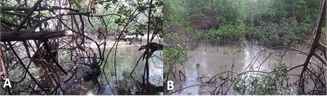
(Fig. 2a).
Líbano: This extensive
mangrove area exhibits a high presence of red mangrove (Rhizophora mangle),
alongside black mangrove (Avicennia germinans). Water access for this
site is through channels, and the substrate consists of mud (Fig. 2a). Right
along the inner edge of the mangrove, with a sandy-muddy substrate, R. mangle
is the dominant species, with L. racemosa and P. rhizophorae
also present (Fig. 2b).
Figura 1.
Map of the sampling site, El Libano and Punta Chame,
Chame district, West Panama, Panama
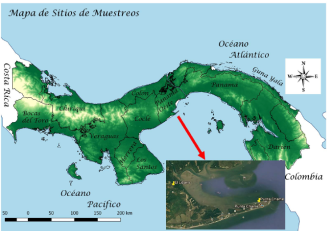
Figura 2a.
A Punta Chame sector, site where the samplings were
carried out; sand-mud substrate. 2b: B Lebanon sector, sampling site with muddy
substrate.
Field Methodology: Two sections were
established in the field: Section A (Punta Chame) and Section B (El Líbano);
each consisting of three quadrants of 100 m², spaced 200 meters apart. Field
outings were conducted during low tide over six months, twice a month. The
dates and times for collection outings were determined using tide prediction
tables for the Pacific of Panama. Three adult mangroves were randomly sampled
within the quadrants, collecting specimens from the mud surrounding the
mangrove, as well as from the roots and trunk. Plastic bags were labeled with
the section, date, and substrate type (trunk, root, or mud) for collecting
biological materials. Only one living representative was taken from each
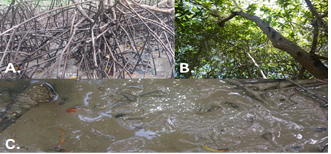
sample, with all individuals found within the quadrant counted (Fig. 3).
Figura 3.
Substrates where the samples were taken (A. root; B.
trunk; C. mud).
Laboratory Procedure: The collected material
was deposited in the Malacology Museum of the University of Panama (MUMAUP) for
identification. Prior to identification, the soft bodies of the specimens were
separated from the shells and then dried in an oven. Identification was based
on the morphological characteristics of the shell, including the aperture,
siphonal canal, and, for some gastropods, additional information such as folds
or teeth on the inner lip; types of teeth and muscle scars in Pelecypoda.
Taxonomic identification was assigned using "Seashells of Tropical West
America" (Keen, 1971) for Gastropoda and Pelecypoda, and "Bivalve
Seashells of Tropical West America" (Coan & Valentich-Scott, 2012)
exclusively for Pelecypoda. Taxonomic updates were cross validated against the
World Register of Marine Species (WoRMS, 2025).
Statistical Analysis: Data processed during
the research were tabulated using Excel. The statistical analysis utilized in
this study employed the Past 3.0 software along with mathematical calculations
such as the Shannon-Wiener Diversity Index (H’), Dominance (D’), and Equitability
(J’).
Commercial Mollusk
Survey: To better understand the species utilized in our studied locations, a
survey was conducted with 40 individuals regarding consumption and extraction
of shellfish. Questions addressed frequency of consumption, most consumed species
by residents, product origin, and perceptions of population declines.
RESULTS
A total of 303
individuals were recorded across six families and seven species in six genera;
the genus with the highest number of species was Polymesoda Rafinesque
1820, represented by two species. The highest counts obtained through genotypic
technology were Leukoma asperrima (G.B. Sowerby I, 1835) (135 organisms;
44.55%), while Isognomon recognitus (Mabille, 1895) was represented by a
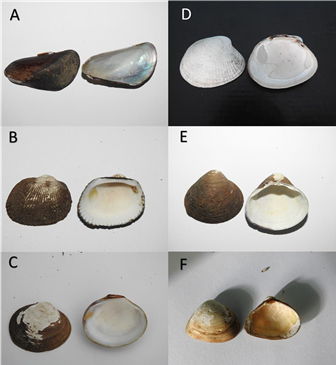
single specimen (0.33%) (Fig. 4 and Table 1). Among the substrates, roots (one
individual) and mud (302 individuals) were the only habitats where specimens
were found, totaling 303 individuals. In the roots, only I. recognitus
(0.33% of total) was present in the root substrate (Table 2); L. asperrima
was the most representative species within the mud, comprising 135 individuals
(44.55%) (Table 2). The Pelecypoda class exhibited an H' index of 1.509, while
data based on Dominance (D') revealed a higher value within the class
Pelecypoda (Table 4).
Punta Chame (Sector A):
Two families were accumulated in this site, located at the inner edge of a
mangrove with sandy-muddy substrate (303 individuals from two orders, six
families, six genera, and seven species). The genus with the highest number of
species was Polymesoda represented by two species, with L. asperrima
being the most common, totaling 135 individuals (44.55%). Conversely, I.
recognitus had one specimen and constituted 0.33% of the total species
(Table 1). The pelecypods were confined to the root substrate (one individual)
and the mud (302 individuals), totaling 303 individuals. Within the root
substrate, only one individual of I. recognitus was found (0.33% of
total); L. asperrima was the most representative species in the mud with
135 individuals (44.55%) (Table 2). The Pelecypoda class exhibited a diversity
index of H’=1.509, with a dominance value (D’) of 0.2797 and equity of
J’=0.7754 (Table 4).
Líbano (Sector B): The
fact that this mangrove ecosystem is located at the outer edge refers in this
case to the association of bivalves with the mangrove or the muddy substrate. A
clear vertical capture of samples from trunk, root, and mud showed that only 16
marines Bivalvia (Pelecypoda) were present within four species belonging to
four genera and families. The dominant genus was Anadara Gray, 1847,
with Anadara tuberculosa G.B. Sowerby I, 1833 being the most
representative species (Fig. 5), comprising 11 specimens and constituting 0.23%
(Table 1 and 3). The corresponding diversity index for the Pelecypoda class was
H’=0.9507, with equity J’=0.685 and dominance D’=0.5078 (Table 4).
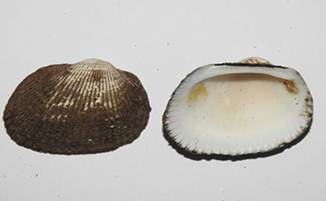
Figura
4.
Chame
Bay Pelecypods: A. Mytella guyanensis. B. Anadara
tuberculosa, C. Polymesoda notabilis, D. Leukoma aspérrima, E. Polymesoda
inflata, F. Panamicorbula ventricosa.
Figura
5.
Anadara
tuberculosa (Sowerby, 1833) la especie más consumida y la más sobreexplotada de
la Bahía de Chame, Chame, Provincia de Panamá Oeste.
DISCUSSION
Seven species of
Pelecypoda, six genera, and six families were observed, totaling 319
individuals. Previous studies in the Pacific of Panama, particularly in
Veraguas, have documented collections conducted by Hertlein in Bahía Honda
(Strong & Hertlein, 1939) using drags and manual collection by local divers
studying coral reefs. In Aguadulce, Tejera and Avilés (1975-1976) identified 35
species of pelecypods; Diéguez and Avilés (1981) recorded 83 species of
commercially important pelecypods in the mangrove area of Bahía de Chame;
Gonzáles (1983) reported 35 pelecypods in the Pacific coast (in the districts
of Zona and Las Palmas); Morao (1983) noted 22 species in the northeastern
coast of Venezuela between January and March of 1983; Avilés (1984) documented
45 pelecypods; Emmen & Tejada (1950) studied the distribution, abundance,
and diversity of Pelecypoda in a mangrove in Aguadulce, finding 12 species of
pelecypods; Lalana & Perez (1985) collected 14 species in the mangroves of
Laguna and 23 species for the mangroves of the Caribbean cays of Cuba; Flores
& Morales (2001) reported 89 species of bivalves from the sands of Santa
Catalina and in their study on the diversity and abundance of pelecypods,
Fairchild & López (2010) identified a total of 52 species of Bivalvia.
Comparisons between
studies in Brazil and other regions indicated that this class is less diverse
and abundant in mangroves, a situation like our findings, supported by Frith et
al. (1976), who discovered that Pelecypoda distribution was rare in
mangroves with salinity fluctuations due to tides, while occurrence within
mangroves was higher under relatively stable saline conditions. While the
number of pelecypods recorded in our study is low, this outcome may be
explained by the proximity of the sampling sites to estuaries with significant
salinity variations. Most organisms exhibit general behaviors that restrict
their activities to favorable habitats (Meadows & Campbell in Spight,
1977), making habitat selection a crucial factor influencing distribution
patterns. The quality and quantity of species are contingent upon tidal range,
wave intensity, and substrate type (Vegas, 1971); species that avoid wave
impacts and desiccation stress by burying themselves in sand or mud are found
in sandy and muddy substrates. Conversely, although sand is more frequently
disturbed, species deposited in these areas are less exposed and less likely to
be moved (Rodríguez, 1967); consequently, we observed a higher number of
individuals in the mud.
Species diversities (H')
in our two study areas were as follows: Punta Chame H’= 1.835 and El Líbano H’=
1.596. Both indices are notably low, confirming that Punta Chame is more
diverse than El Líbano, as indirectly demonstrated by the higher number of individuals
seen in the physical data. This is evident in the dominance values, with D’=
0.2035 for Punta Chame, while El Líbano had a slightly higher value D’= 0.2543,
indicating communities where species are numerically superior to others. Punta
Chame (J' = 0.6777) is comparable to some countries regarding equity value,
while El Líbano (J' = 0.6422) appears low for that group. Both sites exhibited
low diversity; however, Punta Chame (H’=1.835) showed slightly greater
diversity than El Líbano (H’=1.596). Punta Chame is situated at the inner edge
of the mangrove, closer to the beach, whereas El Líbano lies at the outer edge
of these forests, nearer to continental or human-populated areas.
The results of the
dominance and equity indices suggest a homogeneous distribution; both sites
display an equitable distribution of species, although the physical data imply
marked dominance, aligning with Margalef (1995), who indicated that in a
community where one species numerically dominates another, community diversity
is low. The low diversity values are associated with significant sedimentation
in El Líbano and pollution generated by human activities; hence, our records
are considerably lower than those documented by other authors throughout the
Panamanian Pacific, such as in studies conducted in Bahía de Chame (Diéguez
& Avilés, 1981) and in Líbano (Fairchild & López, 2010). Specifically,
Ortega et al. (1986) noted that communities differ in species diversity
in relation to substrate type, dehydration risks, predation, and food
availability. Mollusk diversity, as stated by Jackson (1972), is influenced by
environmental factors such as turbidity, temperature, water pH, salinity, and
grain size.
The mollusk species
collected by us and consumed by the local population include A. tuberculosa,
known as black shell, a significant source of protein and economic resource
among coastal inhabitants, typically consumed in ceviche, rice dishes, among
other recipes (Tejera et al., 2016). We found it to be the most
exploited species in the area and along the Pacific coast; M. guyanensis
is frequently harvested, adhering to roots and forming part of the human diet.
Its soft flesh is nutritionally valuable as a protein source, ranking second
internationally in species consumed after sardines (Tejera et al.,
2016); L. asperrima, the white clam, is edible and used in cocktails,
ceviches, and rice dishes (Tejera et al., 2016); P. ventricosa is
consumed in Bahía de Chame, although many residents are unaware, as they are
sold in mixed "clam" bags (Tejera et al., 2016); species such
as P. inflata and P. notabilis are also consumed in small
quantities. The genus Polymesoda, native to the Americas, is the most
exploited fishery resource in countries like Colombia and Venezuela, and it is
classified as "vulnerable" on the list of threatened species in the
Colombian Caribbean (INVEMAR, 2002). The deforestation of mangroves for
charcoal production, excessive shrimp extraction by external individuals for
sale, pollution, and its impact from shrimp farm development are likely
responsible in varying proportions (Macintosh, 1988 and Macintosh & Ashton,
2002).; also, in this document); all of this has led to reductions in available
stocks for artisanal fishers in this area. The mollusk species most consumed by
residents, in order, are: A. tuberculosa, M. guyanensis, L.
asperrima, P. ventricosa, P. inflata, and P. notabilis;
in this regard, the data gathered from the survey and other studies suggest
that no other species harvested by the inhabitants of Punta Chame Bay (and
likely along the Pacific coast of Panama) has been subjected to greater fishing
pressure than A. tuberculosa (Nagabhushanam & Dhamne, 1977).
CONCLUSION
The observed low
population levels and limited diversity of these species in the mangroves of
the Chame district can be largely attributed to anthropogenic activities such
as mangrove deforestation for charcoal production, excessive extraction by
external settlers for commercial purposes, pollution, and the establishment of
shrimp farms.
ACKNOWLEDGMENTS
We
would like to thank with all our hearts our advisors: Janzel Villalaz, Victor
Tejera and Daniel Emmen who thanks to their knowledge have achieved an
excellent work of our thesis, to the staff of the Malacology Museum of the
University of Panama (MUMAUP), for providing us with a space to carry out the
laboratory work, and without leaving behind our colleagues Jean Carlos Abrego,
Freddy Nay, Eddier Rivera, Helio Quintero, Enós Juárez, Isela Guerrero,
Alejandro Ávila, Emeli Barrios, Jessenia Espinosa, who contributed their time
to accompany us on our field trips, also to Mr. Casimiro Calles for lending us
his machete on the sampling days and to Mr. Carlos Abrego for giving us lodging
and food every day that we needed to go to the field.
REFERENCES
Avilés,
M.C. (1984). Moluscos provenientes de la Isla Pedro Gonzáles, Archipiélago de
las Perlas, Panamá. Donax panamensis, 37,21.
Cárdenas-Calle,
M. & Mair, J. (2014). Caracterización de macroinvertebrados bentónicos de
dos ramales estuarinos afectados por la actividad industrial, estero Salado –
Ecuador. Revista
Intrópica,
9, 118-128.
https://revistas.unimagdalena.edu.co/index.php/intropica/article/view/1439/819
Coan,
E.V. & Valentich-Scott, P. (2012). Bivalve seashells of tropical west
America. Santa Barbara Museum of Natural History Monographs. Santa Barbara,
United State.
Connell,
J. (1961). Effects of completion, predatory by Thais lapillus and other
facture on natural populations of the barnacles Balanus balaniudes. Ecological Monographs, 31, 61-103.
Diéguez,
M. & Avilés, M.C. (1981). Contribución al conocimiento de los bivalvos de
interés económicos del pacifico de Panamá. Panamá: II congreso Nacional de
Acuicultura Memorias MIDA, Panamá.
Emmen,
D. & Tejada, R. (1984). Estudio De la Distribución, Abundancia y diversidad
de Pelecípodos y Gasterópodos de un Manglar del distrito de Aguadulce. Tesis.
Panamá, Panamá.
Fairchild,
N.M & López S.I. (2010). Diversidad y Abundancia de Moluscos de Manglar
(Bivalvos y Gasterópodos) en el Líbano y áreas adyacentes en la Bahía de chame,
Provincia de Panamá. Tesis. Panamá, Panamá.
Flores,
C. (1973). La familia Littorinidae (mollusca: Mesogastropoda) en las aguas
costeras de venezuela. Boletín del Instituto Oceanográfico de la Universidad de
Oriente, ubicado en Cumaná, 12, 3-22.
Flores,
O. & Morales, L. (2001). Moluscos de la clase Pelecypoda y Gastropoda de la
ensenada e isla Santa Catalina, pacifico veragüenses. Tesis. Panamá, Panamá.
Franz,
D. (1976). Benthic assemblages in relation to sediment gradients in the
northeast Long Island sound. Malacología, 15(2), 372-399.
Frith,
D.W., Tantanasiriwong, R. & Bhatia, O. (1976), zonation and abundance of
macrofauna on mangrove shore, Phuket Island. Research Bulletin Phuket Marine Biological Center, 10,
1-31.
Gaxiola,
M. (2011). Una revisión sobre los manglares: características, problemáticas y
su marco jurídico. Importancia de los manglares, el daño de los efectos
antropogénicos y su marco jurídico: caso sistema lagunar de Topolobampo. Ra
Ximhai: revista científica de sociedad, cultura y desarrollo sostenible, 7(3),
355-369.
Gonzalez,
G.R. (1983). Informe de las especies de molusco colectadas durante la gira de
barro colorado salud. No. 7 a la costa Pacífica de Veraguas. Donax
panamensis, 29, 66-72.
Haven,
S. 1971. Niche
differences in the intertidal Limpets Acmea scabra and Acmea
digitales in Central California. Veliger, 13, 231-248.
Instituto
Geográfico Nacional Tommy Guardia (IGNTG). (2007). Atlas Nacional de la
República de Panamá. 4ta edición. Quebecor World Bogotá. Editora Novo Art S.A.
Colombia.
INVEMAR.
(2002). Informe del estado de los ambientes marinos y costeros de Colombia: Año
2002. Serie de Publicaciones Especiales INVEMAR, No. 8, Santa Marta, Colombia.
Jackson,
J. (1972). the ecology of the mollusks of Thalassia communities,
Jamaica. West
Indies. II. Mollusks population variability along an enviromental stress
gradiente. Marine
biology, 14, 304-337.
Jiménez,
J.A. (1994). Los manglares del Pacífico centroamericano. UNA, Costa Rica.
Keen,
A.M. (1971). Seashells of Tropical West America. Marine Mollusk from Baja
California to Perú. Stanford University Press. Stanford, California, United
State.
Lalana,
R. & Pérez, M. (1985). Estudio
cualitativo y cuantitativo de la fauna asociada a las raíces de Rhizophora
mangle en la cayería este de la Isla de la Juventud. Revista de
Investigaciones Marinas, VI (2-3), 45-57.
Macintosh,
D.J. (1988). The ecology and physiology of decapods of mangrove swamps.
Symposia of the Zoological Society of London, 59, 315-341.
Macintosh,
D.J. & Ashton, E.C. (2002). A Review of Mangrove Biodiversity Conservation and
Management. Centre for Tropical Ecosystems Research, Aarhus, Denmark.
http://mit.biology.au.dk/cenTER/index.html
Margalef,
R. (1995). Aplicacions del caos determinsita en ecologia (pp 171-184) En: Flos,
J. (ed.) 1995. Ordre i caos en ecologia. Publicacions Universitat de Barcelona,
España.
Morao,
A. (1983). Diversidad y fauna de moluscos y crustáceos asociados a las raíces
sumergidas del mangle rojo, Rhizophora mangle en la Laguna de la
Restinga. Tesis. Universidad de Oriente, Venezuela.
Morton,
B. (1983). Mangrove bivalves. In The Mollusca: Ecology. Russell-Hunter.
Nagabhushanam,
R. & Dhamne, K.P. (1977). Seasonal gonadal changes in the clam Paphia
laterisulca. Aquaculture, 10, 141-152.
Newell,
G.E. (1958). The behavior of Littorina littorea (L). under natural
conditions and its relations to position on the shore. Journal of the Marine
Biological Association UK, 37, 229- 239.
Olguín,
E., Hernández, M. & Sánchez, G. (2007). Contaminación de manglares por hidrocarburos y estrategias
de biorremediación, fitorremediación y restauración. Revista internacional de
contaminación ambiental, 23(3), 139-154. http://www.scielo.org.mx/scielo.php?script=sci_arttext&pid=S0188-49992007000300004&lng=es&tlng=es.
Ortega,
S. (1986). Fish predation on the gastropods in the Pacific coasts of Costa
Rica. Journal of Experimental Marine Biology and Ecology, 97, 181-191.
PANAMANGLAR.
(2013). http://panamanglar.org/es/listing/bahia-de-chame/
Pfaff,
M.C. & Nel, R. (2019). Intertidal zonation. Reference module in earth
system and environmental sciences. Second Edition, United States. https://doi.org/10.1016/B978-0-12-409548-9.11184-4
Pomareda,
E., & Zanella, I. (2006). Diversidad
de moluscos asociados a manglares en isla San Lucas. Revista de Ciencias
Ambientales, 32(1), 11-13.
Rodríguez,
G. (1967). Comunidades bentónicas. En: Ecología marina. Eds: fundación La Salle
de Ciencias Naturales. Argentina.
Rützler,
K. & Feller, C. (1988). Mangrove swamp communities. Oceanus, 30, 16-24.
Spigth,
T.M. (1977). Diversity of shallow water Gastropod Communities on temperature
and tropical beaches. The American Naturalis, 3(982), 1077-1097.
Strong,
A.M. & Hertlein, L.G. (1939). Marine mollusk from Panamá collects by Allan
Hancock Expedition to the Galapagos Islands, 1931- 1932 En: Allan Hancock
pacific vol. 2 (12), p.177-184. California: The University of southern
California press, United States.
Tejera,
V.H. & Avilés, M.C. (1975). Lista de gasterópodos de la costa del Distrito
de Aguadulce, Provincia de Coclé, República de Panamá. Conciencia, 2(2), 5-6 y 15.
Tejera,
V.H. & Avilés, M.C. (1976). Inventario de flora y fauna de costas del
distrito de Aguadulce. Primera parte: Clase Pelecypoda. Conciencia, 3(3),
10-11.
Tejera,
V.H., Avilés, M.C. & Córdoba D. (2016). Moluscos Intermareales del Distrito
de Aguadulce. Guía de campo. Imprenta: Color Group Internacional. Panamá,
Panamá.
Vegas,
M. (1971). Introducción a la ecología de los bentos marinos. O.E.A Washintong D.C.;
United States.
WORLD
REGISTER OF MARINE SPECIES (WoRMS). Editorial Board (2025). World Register of
Marine Species. Available from http://www.marinespecies.org
 , Joan Antaneda2