
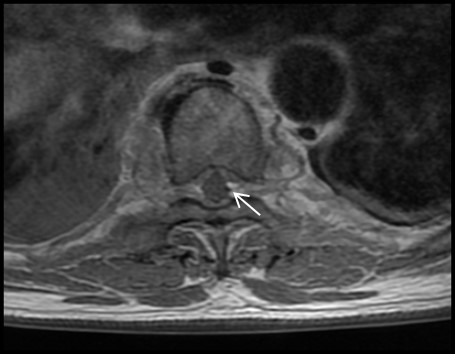
Spinal epidural abscess is a rare infection affecting central nervous system that causes severe neurologic symptoms leading to important neurological function aftermath if not treated appropriately. The clinical presentation is nonspecific, the lumbar pain, fever and neurological deficit triad is key to the diagnosis but the symptoms appear at different times in most cases. Magnetic resonance with gadolinium contrast is the gold standard imaging study for the diagnosis. Microbiological diagnosis is made by drainage and culture of spinal mass. Management consists of surgery, antibiotic therapy and radiological monitoring.
We present the case of a 68 years old male with symmetric ascending paresis, oliguria, later associated to urinary and fecal incontinence, fever and lumbar tenderness which was diagnosed as spinal epidural abscess.

Downloads
Download data is not yet available.
References
Darouiche R. Spinal Epidural Abscess. N Eng J Med. 2006 noviembre; 355(19).
Davis D, Salazar A, Chan T, Vilke G. Prospective evaluation of a clinical decision guideline to diagnose spinal epidural abscess in patients who present to the emergency department with spine pain. J Neurosurg Spine. 2011 junio; 14.
Arko IV L, Quach E, Nguyen V, Chang D, Sukul V, Kim B-S. Medical and surgical management of spinal epidural abscess: a systematic review. Neurosurg Focus. 2014 agosto; 37(2).
Do Kim S., Melikian R., Ju K., Zurakowski D., Wood K., Bono C., Harris M. Independent predictors of failure of nonoperative management ofspinal epidural abscesses. The Spine Journal. 2014; 14.
Tunkel A. Subdural Empyema, Epidural Abscess, and Suppurative Intracranial Thrombophlebitis. In I B, editor. Mandell, Douglas, and Bennett's Principles and Practive of Infectious Diseases. Eight ed. Philadelphia: Elsevier Inc; 2015. p. 1117-1185.
Fang W, Chen S, Huang D, Chang K. Post- traumatic Osteomyelitis with Spinal Epidural Abscess of Cervical Spine in a Young Man with No Predisposing Factor. J Chin Med Assoc. 2009 abril; 72(4).
Sendi P, Bregenzer T, Zimmerli W. Spinal epidural abscess in clinical practice. Q J Med. 2008; 101.
Zimmerer S, Conen A, Müller A, Sailer M, Taub E, Flückiger U, Schwenzer-Zimmerer K. Spinal epidural abscess: aetiology, predisponent factors and clinical outcomes in a 4-year prospective study. Eur Spine J. 20011 mayo; 20.
Verma R, Chaudhari TS, Lachuriya G. Spontaneous extensive spinal epidural abscess presenting as acute quadriparesis. BMJ Case Rep. [serial on the internet].; [citado 2015 enero 2].10. [about 2 pages] Available from: http://casereports.bmj.com/.
Calvo C, Cartes C, González-Hernández J. Absceso Epidural Espinal: Caso clínico y revisión de la literatura. Revista Memoriza.com. 2010; 7: p. 14-21.
Patel A., Alton T., Bransford R., Lee M., Bellabarba C., Chapman J. Spinal epidural abscesses: risk factors, medical versus surgical management, a retrospective review of 128 cases. The Spine Journal. 2014; 1

