
Copyright (c) 2026 Revista Científica Orbis Cógnita

This work is licensed under a Creative Commons Attribution-NonCommercial-ShareAlike 4.0 International License.
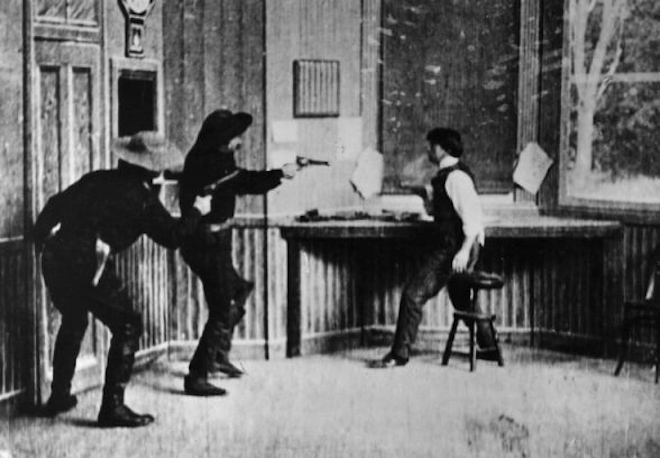
Since its beginnings, cinematography has transcended its documentary function to become a key medium in the symbolic representation of social realities. This article analyzes the role of cinema in the construction and problematization of collective identity, focusing on the United States between 1900 and 1910, a period when it began to consolidate as a cultural and ideological instrument. Drawing on Siegfried Kracauer’s theoretical framework, the study examines how early cinema not only recorded historical events but also projected dominant values, social tensions, and collective aspirations.The research employed a qualitative methodology based on documentary analysis of specialized literature and the short film The Great Train Robbery (1903), a representative work of American cinema of the time. This production shows how the first moving images helped shape a national narrative centered on justice, order, and individual heroism, projecting an idealized vision of progress. Findings indicate that cinema functions as a narrative and symbolic device expressing the collective unconscious. It is concluded that early cinema allows for the interpretation of sociohistorical processes from a critical perspective, highlighting its methodological value for the social sciences and historiography.

Este obra está bajo una licencia de Creative Commons Reconocimiento-NoComercial-CompartirIgual 4.0 Internacional.